
Payment Mechanism, Availability Payments, and Performance Deductions in Infrastructure Projects
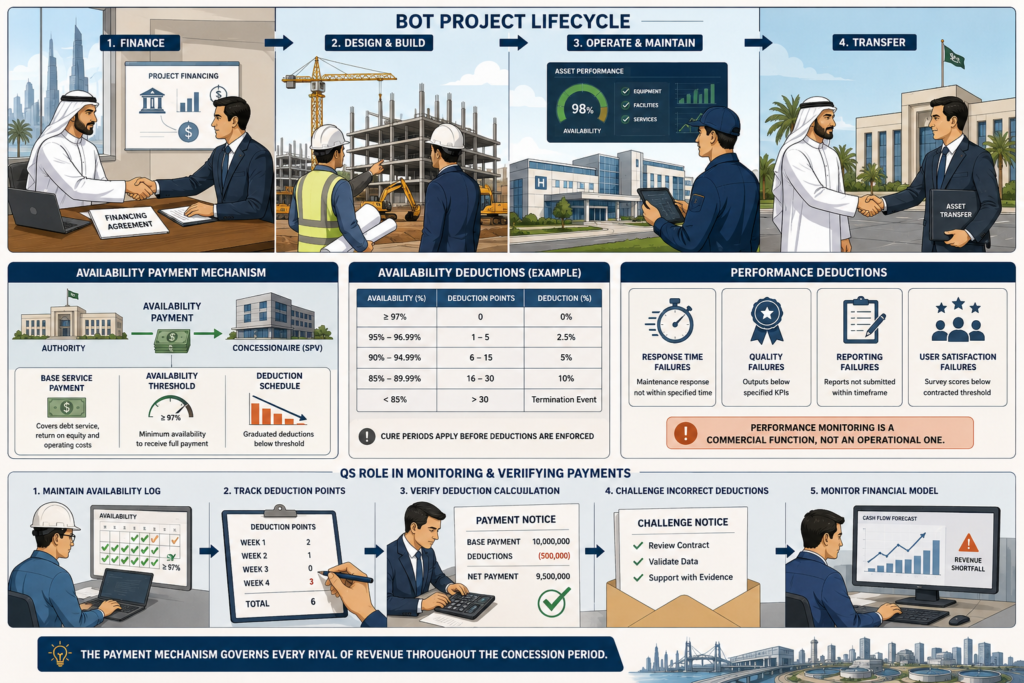
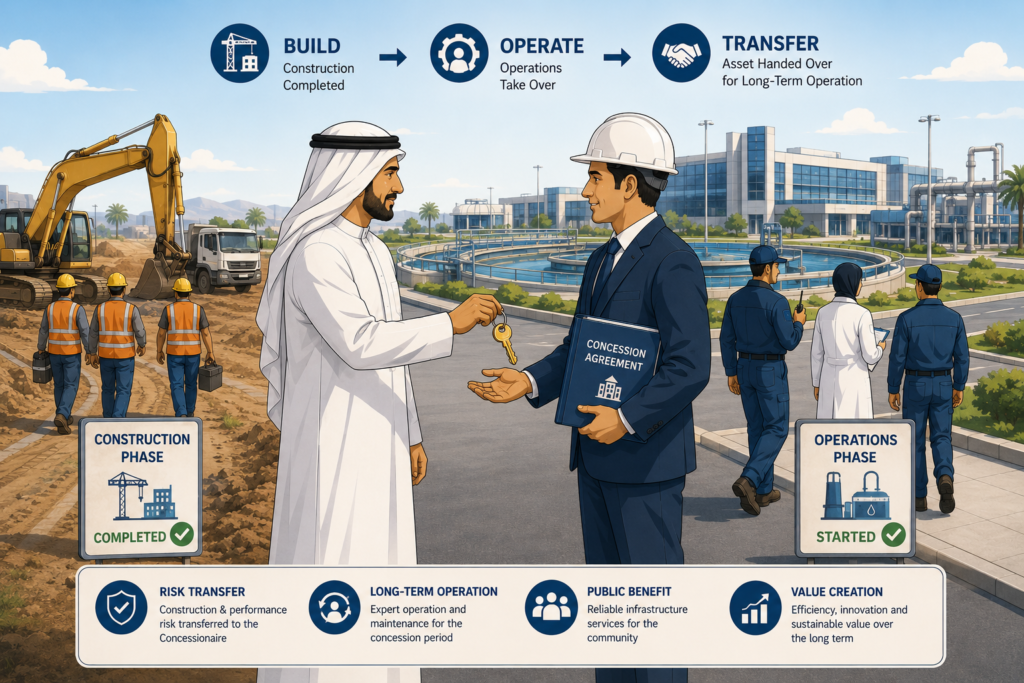
Build-Operate-Transfer (BOT) contracts represent one of the most commercially complex arrangements in the construction and infrastructure sector. Unlike a traditional contract where the contractor builds and hands over to a paying employer, in a BOT concession the concessionaire finances, designs, constructs, and then operates the asset for a defined concession period — recovering investment through a revenue or payment mechanism. At the end of the concession, the asset transfers to the public authority.
Across the Middle East and within Saudi Arabia’s Vision 2030 infrastructure programme, BOT structures are increasingly used for highways, ports, water treatment plants, airports, and social infrastructure. The QS role in a BOT project extends well beyond pre-contract cost planning: it encompasses the commercial assessment of payment mechanisms, the ongoing verification of availability and performance compliance, and the quantification of deductions under the concession agreement.
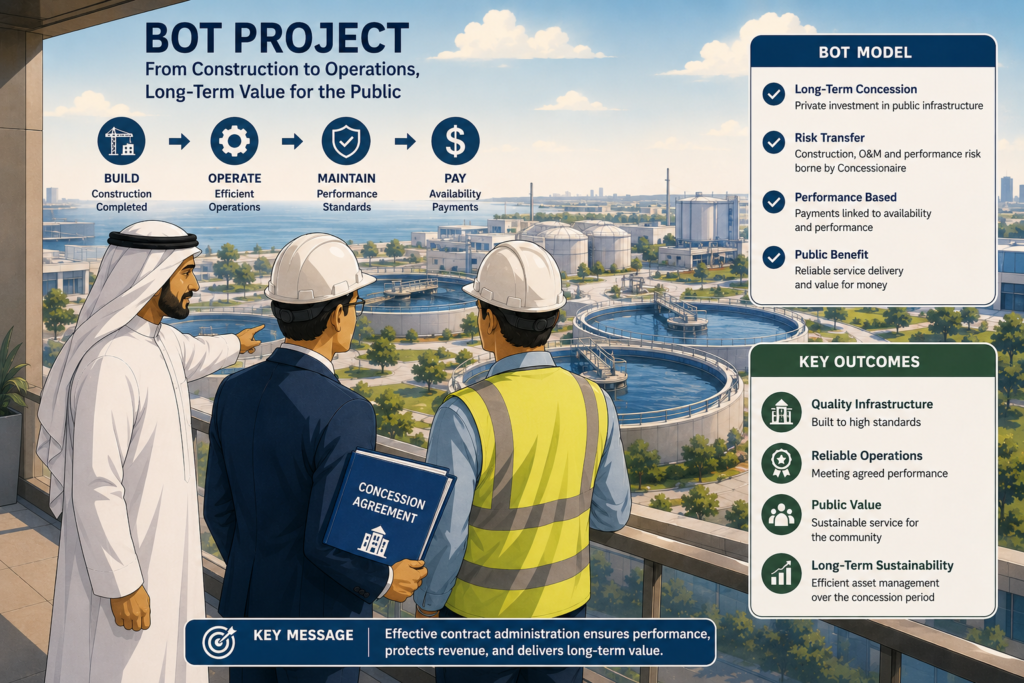
Understanding the payment mechanism is fundamental to understanding the commercial risk profile of a BOT project. The mechanism determines how and when the concessionaire receives revenue, what performance obligations trigger deductions, and what happens to the financial model when availability falls below the contracted threshold.
WHAT YOU WILL LEARN
- The structure of a BOT concession and how it differs from traditional procurement
- How availability payment mechanisms work — the commercial backbone of most social infrastructure BOTs
- How performance deductions are calculated and applied under a concession agreement
- The QS role in monitoring compliance and verifying deductions during the operational phase
- Key commercial risks in BOT structures relevant to developers and infrastructure QS practitioners
The BOT Structure
In a BOT concession, the concessionaire assumes responsibility for the full project lifecycle: raising private finance through a special purpose vehicle, designing and constructing the asset, operating and maintaining it throughout the concession period (commonly 15–35 years), and transferring it to the public authority at the end of the agreed term.
The revenue model determines the commercial risk profile:
- Revenue-based models — concessionaire earns tolls, tariffs, or user charges; demand risk sits with the concessionaire
- Availability payment models — the public authority pays a periodic service payment provided the asset meets specified availability and performance standards; demand risk sits with the public authority
- Hybrid models — combination of availability payments and revenue sharing
In Saudi Arabia and GCC infrastructure projects, availability payment models are increasingly preferred for social infrastructure where the public authority retains demand risk but requires private sector operational efficiency.
➤ The choice of revenue model is the single most significant commercial decision in a BOT structure — it determines who bears the risk of underperformance throughout the entire concession period.
Availability Payment Mechanism
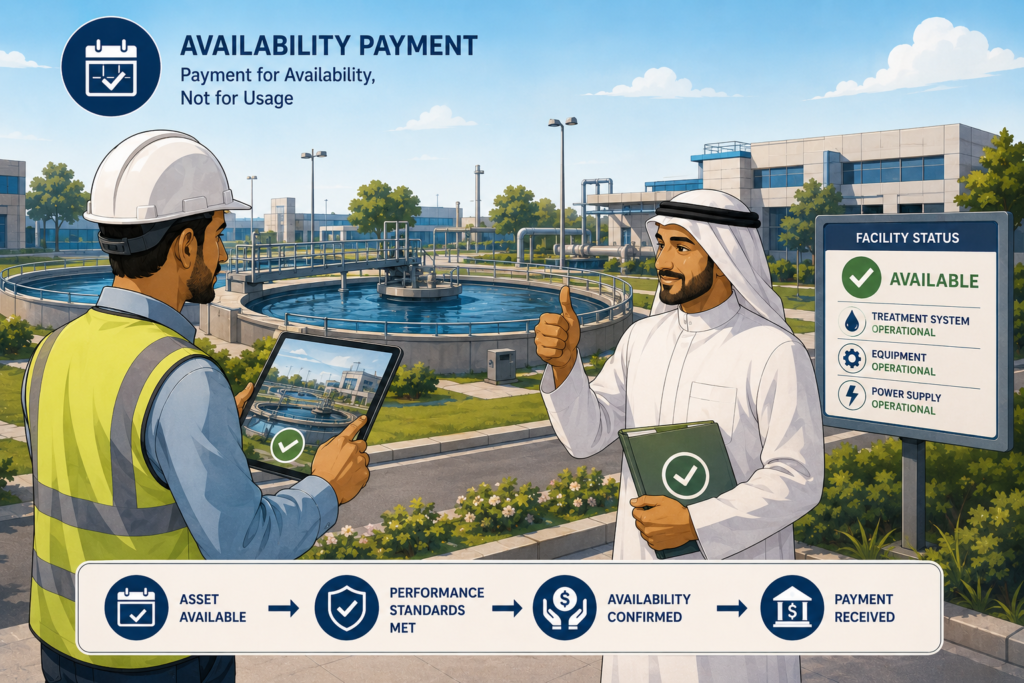
The availability payment is a periodic payment (typically monthly or quarterly) paid by the authority to the concessionaire, conditional on the asset being available to the specified standard for the specified number of hours or percentage of time. The payment is not linked to actual usage — it is linked to the asset being in a condition ready to be used.
Key elements of a typical availability payment mechanism:
- Base service payment — the monthly payment covering debt service, return on equity, and operating costs assuming full availability
- Availability threshold — the minimum percentage of time the asset must be available to receive the full payment (commonly 97–99% depending on asset type)
- Deduction schedule — graduated deductions when availability falls below threshold, from partial deductions to termination-level events
The payment mechanism document within the concession agreement typically defines:
- How “availability” is measured for each facility type or service stream
- The deduction points system and conversion of deduction points to financial deductions
- Cure periods within which the concessionaire can remedy failures before deductions apply
- Sustained failure thresholds that trigger a performance event or step-in right
Performance Deductions
Performance deductions are separate from availability deductions and relate to the quality of service delivery rather than simple asset availability. A hospital corridor may be available, but if cleaning standards, response times, or helpdesk performance fall below specification, performance deductions apply.
Common performance deduction categories on social infrastructure BOTs:
- Response time failures — maintenance response not within specified timeframes
- Quality failures — outputs falling below specified KPIs measured by the authority’s monitoring team
- Reporting failures — non-submission of performance data within required timeframes
- User satisfaction failures — where end-user survey scores fall below the contracted threshold
➤ Performance monitoring is a commercial function, not an operational one. The QS must understand the deduction mechanics to verify that the authority is applying deductions correctly and that challenges to deductions are commercially founded.
PRACTICAL QS APPROACH
The QS role on a BOT project during the operational phase involves monthly review of the authority’s payment notice, verification of deduction calculations against the payment mechanism, and preparation of challenge notices where deductions are incorrectly applied.
Key activities for the operational QS on a BOT:
- Maintain a monthly availability log against the contracted threshold
- Track deduction points accumulated and compare against the deduction schedule
- Verify the authority’s monthly deduction calculation independently before it is accepted
- Prepare commercial responses to disputed deductions within contractual notice periods
- Monitor the project financial model against actual payment receipts to flag revenue shortfalls
FINAL THOUGHT
BOT concession structures are commercially sophisticated instruments. The payment mechanism is not a passive document — it is the primary commercial control mechanism for the entire concession period. For QS practitioners entering the infrastructure space in Saudi Arabia and the wider GCC, understanding availability payment mechanics and performance deduction frameworks is an essential competency.
Because in reality:
- In a BOT, the construction phase is how you build the asset; the operational phase is how you recover the investment — and the payment mechanism governs every riyal of that recovery
- A concessionaire who does not understand its own payment mechanism will accept deductions it is not obliged to accept and fail to challenge calculations it has every right to dispute