
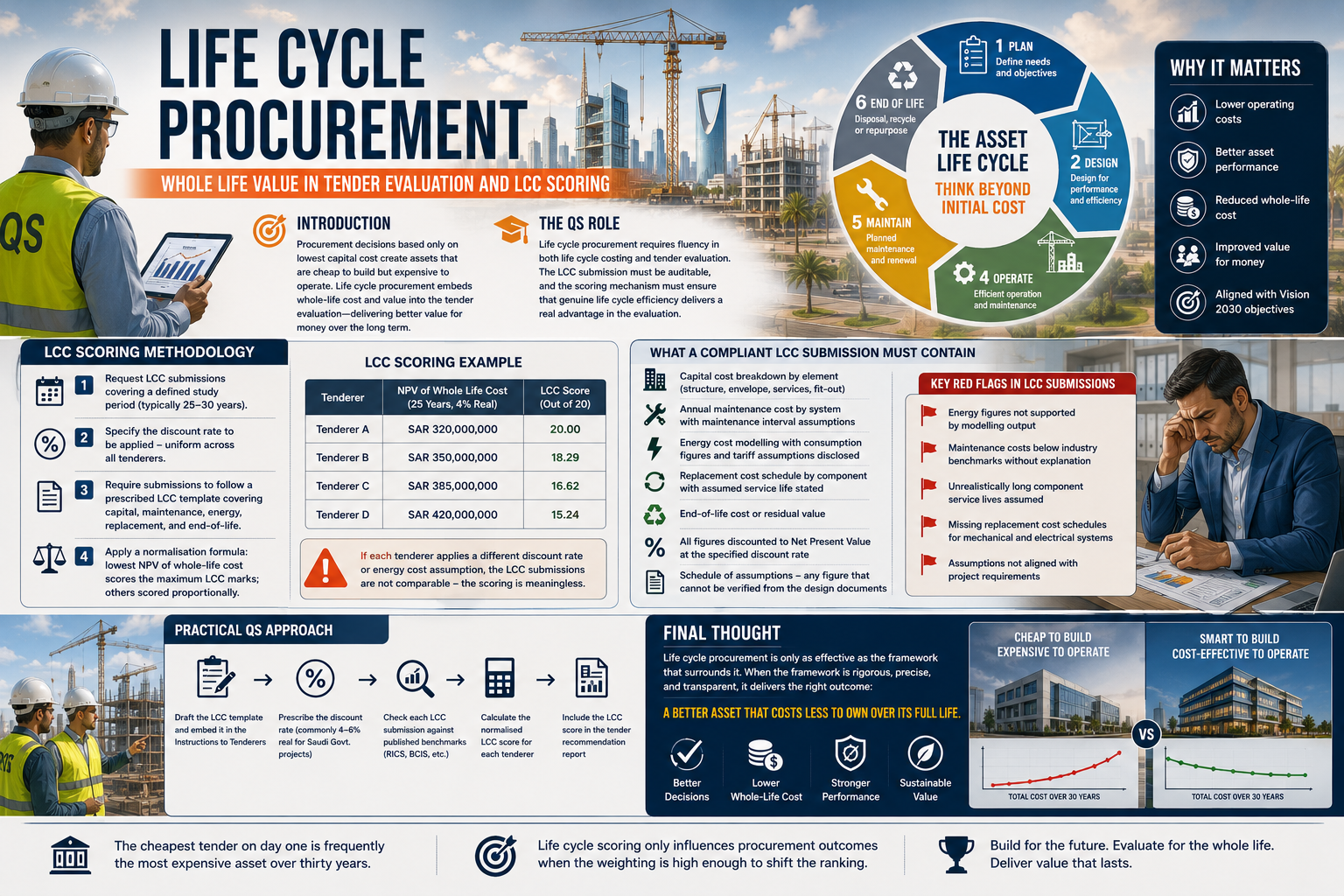
LIFE CYCLE PROCUREMENT
Whole Life Value in Tender Evaluation and LCC Scoring
Introduction
Procurement decisions made purely on capital cost create assets that are cheap to build and expensive to operate. This is a well-documented pattern in construction — and it is especially relevant in the Gulf region, where government clients under Vision 2030 are increasingly required to demonstrate long-term value for money rather than simply lowest initial price. Life cycle procurement is the process by which whole-life cost and whole-life value are embedded into the tender evaluation methodology before a contract is awarded.
The gap between what procurement teams intend and what they actually evaluate remains wide. A tender panel may include “life cycle” as a scoring criterion, but if it represents five percent of the total evaluation score against ninety-five percent weighted on capital price, it exerts no meaningful influence on contractor selection. Life cycle procurement only works when it is designed into the evaluation framework with appropriate weighting, verifiable submission requirements, and a methodology for converting LCC data into comparable scores.
For the QS, life cycle procurement requires fluency in two disciplines simultaneously: the technical process of life cycle costing, and the commercial process of tender evaluation. Neither alone is sufficient. The LCC submission must be structured so that it is independently auditable, and the scoring mechanism must be calibrated so that genuine life cycle efficiency translates into a material advantage at the evaluation stage.
WHAT YOU WILL LEARN:
- How to integrate LCC scoring into a weighted tender evaluation matrix
- What a compliant LCC submission must contain for evaluation purposes
- How to normalise LCC data across tenders with different assumptions
- The discount rate question: what rate to apply and why it matters
- Common failures in life cycle procurement that defeat its purpose
LCC SCORING METHODOLOGY
The standard approach to scoring LCC submissions in a multi-criteria tender evaluation assigns a defined percentage of the total score to whole-life cost. For public sector contracts in Saudi Arabia, this weighting typically ranges from ten to twenty-five percent depending on asset type. Buildings with long operational lives — hospitals, educational facilities, infrastructure — justify a higher weighting than short-life fit-out projects.
The scoring mechanism converts each tenderer’s LCC submission into a comparative score:
- Request LCC submissions covering a defined study period (typically 25–30 years for permanent buildings)
- Specify the discount rate to be applied — this must be uniform across all tenderers
- Require submissions to follow a prescribed LCC template covering capital cost, maintenance, energy, replacement, and end-of-life
- Apply a normalisation formula: the tenderer with the lowest NPV of whole-life cost scores the maximum LCC marks; others are scored proportionally
➤ If each tenderer applies a different discount rate and a different energy cost assumption, the LCC submissions are not comparable — the scoring exercise becomes meaningless.
WHAT A COMPLIANT LCC SUBMISSION MUST CONTAIN
The employer’s tender documentation must specify the minimum content of the LCC submission in the Instructions to Tenderers. Without prescription, tenderers will submit LCC data in formats that cannot be compared. A compliant LCC submission for a building project should contain:
- Capital cost breakdown by element (structure, envelope, services, fit-out)
- Annual maintenance cost by system with maintenance interval assumptions stated
- Energy cost modelling with consumption figures and tariff assumptions disclosed
- Replacement cost schedule by component with assumed service life stated
- End-of-life cost or residual value
- All figures discounted to Net Present Value at the specified discount rate
- A schedule of assumptions — any figure that cannot be verified from the design documents
Key red flags in LCC submissions:
- Energy figures not supported by modelling output
- Maintenance costs below industry benchmarks without explanation
- Unrealistically long component service lives assumed
- Missing replacement cost schedules for mechanical and electrical systems
PRACTICAL QS APPROACH
On projects in Saudi Arabia where life cycle procurement is mandated, the QS role in tender evaluation includes:
- Drafting the LCC submission template and embedding it in the Instructions to Tenderers
- Prescribing the discount rate (commonly 4–6 percent real for Saudi government projects)
- Conducting a desktop reasonableness check on each LCC submission against published maintenance benchmarks (RICS, BCIS, or regional equivalents)
- Calculating the normalised LCC score for each tenderer
- Including the LCC score in the tender recommendation report alongside the technical and commercial scores
FINAL THOUGHT
Life cycle procurement is only as effective as the framework that surrounds it. A poorly designed LCC evaluation criterion — one that is too low in weighting, too loosely specified, or impossible to verify — signals to tenderers that it can be gamed with optimistic assumptions. The market responds accordingly. When the framework is rigorous, when the submission requirements are precise, and when the scoring is transparent, life cycle procurement delivers its intended outcome: a built asset that costs less to own over its full life.
Because in reality:
- The cheapest tender on day one is frequently the most expensive asset over thirty years.
- Life cycle scoring only influences procurement outcomes when the weighting is high enough to shift the ranking.