
Understanding Extended Site Facility Costs in Construction
(Site Accommodation, Craneage, and Scaffolding During Extension Periods)
INTRODUCTION
When a contractor is awarded an Extension of Time, the conversation frequently focuses on the time itself — the number of days, the critical path analysis, the concurrent delay arguments. What receives less attention, until the prolongation claim is prepared, is the cost of keeping the site operational for the extended period. Extended site facilities represent some of the most significant and most contested costs in prolongation claims on Middle East construction contracts. On a high-rise tower or a major hospital project in Riyadh, the monthly cost of maintaining site accommodation, tower cranes, and scaffold systems can reach hundreds of thousands of dollars — costs that accumulate daily during any extension caused by employer-risk events.
Under FIDIC Red Book 1999, Clause 8.4 grants an Extension of Time where the delay is caused by a qualifying event. If that qualifying event also gives rise to additional cost — which it does when the cause is an employer-risk event such as a Variation, a failure to give access, or a change in legislation — Clause 20.1 entitles the contractor to recover the direct cost of prolongation. Extended site facilities sit at the heart of that cost recovery. They are time-related costs: costs that accrue continuously as a function of time on site, not as a function of physical work completed.
The challenge for the QS is evidencing these costs with the precision required to withstand scrutiny. An engineer who receives a prolongation claim without contemporaneous cost records, without a breakdown of what was on hire and at what rate, and without a clear link between the time-related facility and the delay period, will reject or severely reduce the assessment. The evidentiary standard is high, and it must be met from records that were maintained during the project — not reconstructed afterward.
WHAT YOU WILL LEARN:
- Which site facility costs are recoverable as prolongation under FIDIC
- How to record and evidence time-related facility costs during the project
- How to calculate the extended crane hire, scaffolding, and accommodation cost for a prolongation claim
- The difference between fixed and time-related preliminaries in the context of prolongation
- Common employer arguments against extended site facility costs and how to address them
WHAT COUNTS AS AN EXTENDED SITE FACILITY
Site facilities that are time-related — that is, costs that continue as long as the project is on site regardless of the physical volume of work being executed — are recoverable in prolongation claims. These include:
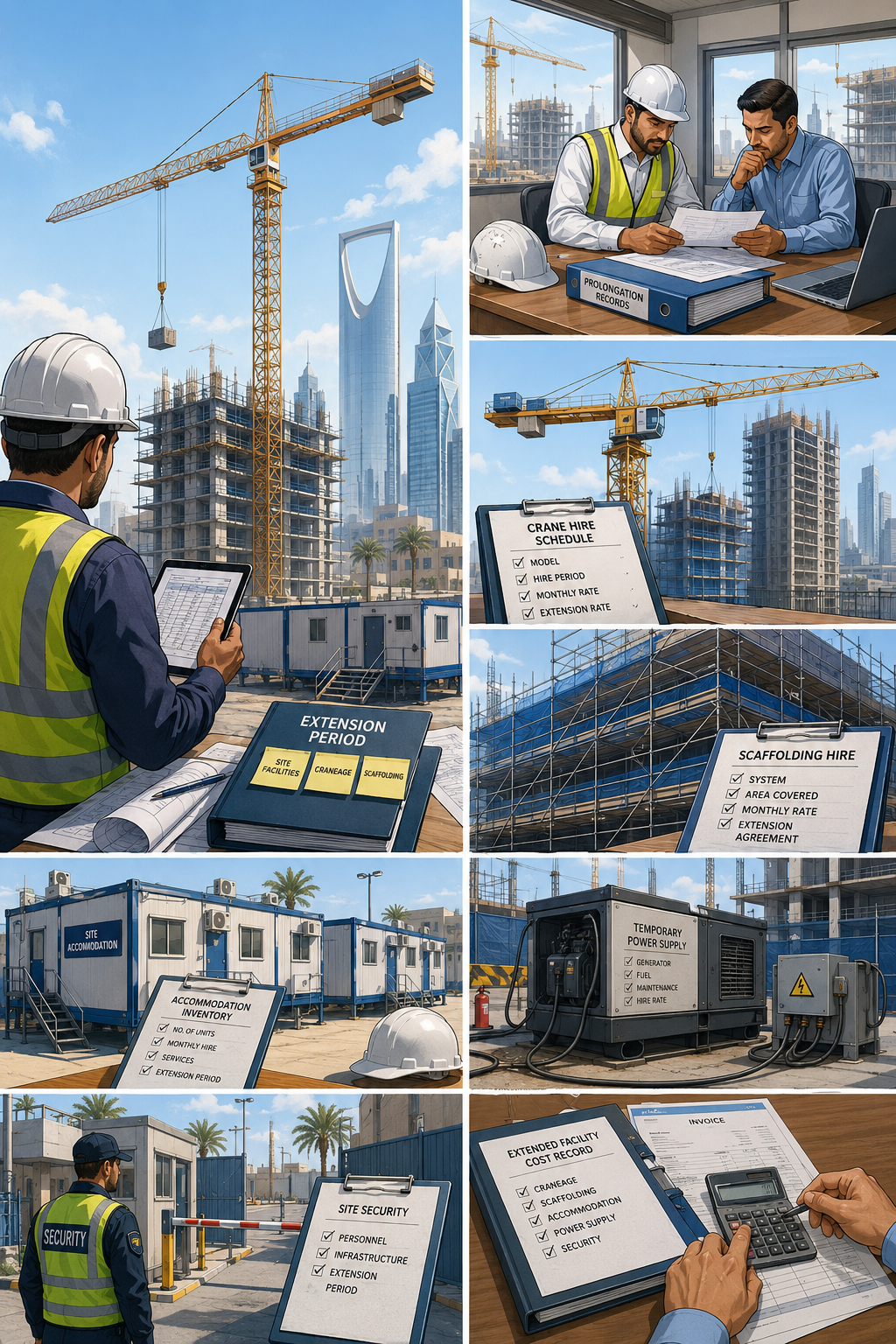
- Tower crane hire: monthly hire rates, operator costs, insurance, maintenance
- Passenger and goods hoist: hire rate, operator, servicing
- Scaffolding: hire rate for scaffold systems retained beyond original programme period
- Site accommodation: office containers, welfare facilities, ablutions, meeting rooms
- Temporary power supply: generators, transformers, cabling maintained during extension
- Site security: security personnel and infrastructure maintained during extension
- Temporary hoarding and fencing: where maintained for the extension period
- Site management and supervision: staff costs for project managers, QS, engineers retained during the extension period (though staff costs are typically claimed separately)
➤ Fixed preliminary items — mobilisation costs, one-time installations — are not recoverable as prolongation; only the time-related portion of site cost accrues during the extended period.

EVIDENCING EXTENDED FACILITY COSTS
The credibility of a prolongation claim for extended site facilities depends entirely on the quality of contemporaneous records. The QS must maintain, throughout the project:
- Crane hire schedules: crane model, hire period, monthly rate, supplier invoices
- Scaffold rental agreements: system, area covered, hire rate, extension agreements
- Accommodation inventory: number of units, monthly hire or depreciation rate, service costs
- Generator logs: fuel consumption, maintenance records, hire or depreciation
- Supplier invoices posted by cost code to enable extraction for the claim period
Practical evidencing principles:
- Maintain a plant and equipment hire register updated monthly
- File all hire agreements with clearly stated extension options and rates
- Record the reason for any equipment being retained beyond its original planned off-hire date
- Link crane and scaffold retention specifically to the delay event in the site records
PRACTICAL QS APPROACH
On FIDIC Red Book contracts in Saudi Arabia, the QS approach to extended site facilities during a delay event includes:
- Identify at the point of the delay event which site facilities are being extended as a direct consequence
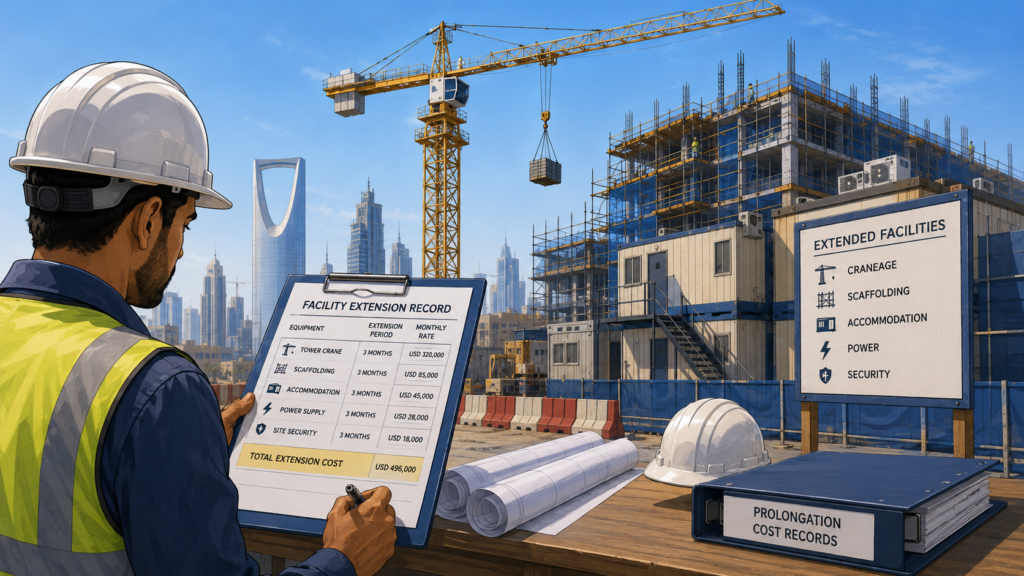
- Issue a contemporaneous cost record identifying the affected equipment and its daily/monthly cost
- Include extended facility costs in monthly prolongation cost records filed under the claim reference
- Separate the pre-extension cost (included in contract price) from the extension period cost (subject to recovery)
- Price the extended facility section of the prolongation claim using actual hire rates from invoices, not BOQ rates which may have been priced to a different programme
FINAL THOUGHT
Extended site facility costs are not speculative — they are real, documented, and continuous. The problem arises not from the costs themselves but from the failure to capture them properly during the project. A crane on hire for three additional months because of an employer-caused delay represents a verifiable, auditable cost that should be fully recoverable. When the records exist, the claim is straightforward. When the records do not exist, the claim becomes an argument about what probably happened — an argument that the engineer will resolve conservatively.
Because in reality:
- Every day a tower crane stays on site during an employer-risk extension, a recoverable cost is accumulating — the QS’s job is to capture it, not reconstruct it.
- Prolongation claims built on contemporaneous records settle faster and for more than those rebuilt from memory.