
BOQ Coding: Essential Guide to Cost Management in Construction
Work Breakdown Structure Coding and Its Link to Cost Reporting
INTRODUCTION
On major construction contracts in Saudi Arabia — high-rise towers, hospital builds, mall renovation programmes a Bill of Quantities is only as useful as its coding structure. Contractors frequently submit BOQs that work perfectly at tender stage but collapse under the weight of post-contract reporting. The codes assigned to each item at tender are the same codes that will govern cost tracking, variation accounting, subcontract back-charging, and management reporting for the entire project lifecycle. When those codes are poorly conceived, the commercial team spends months reconciling data that should flow automatically.
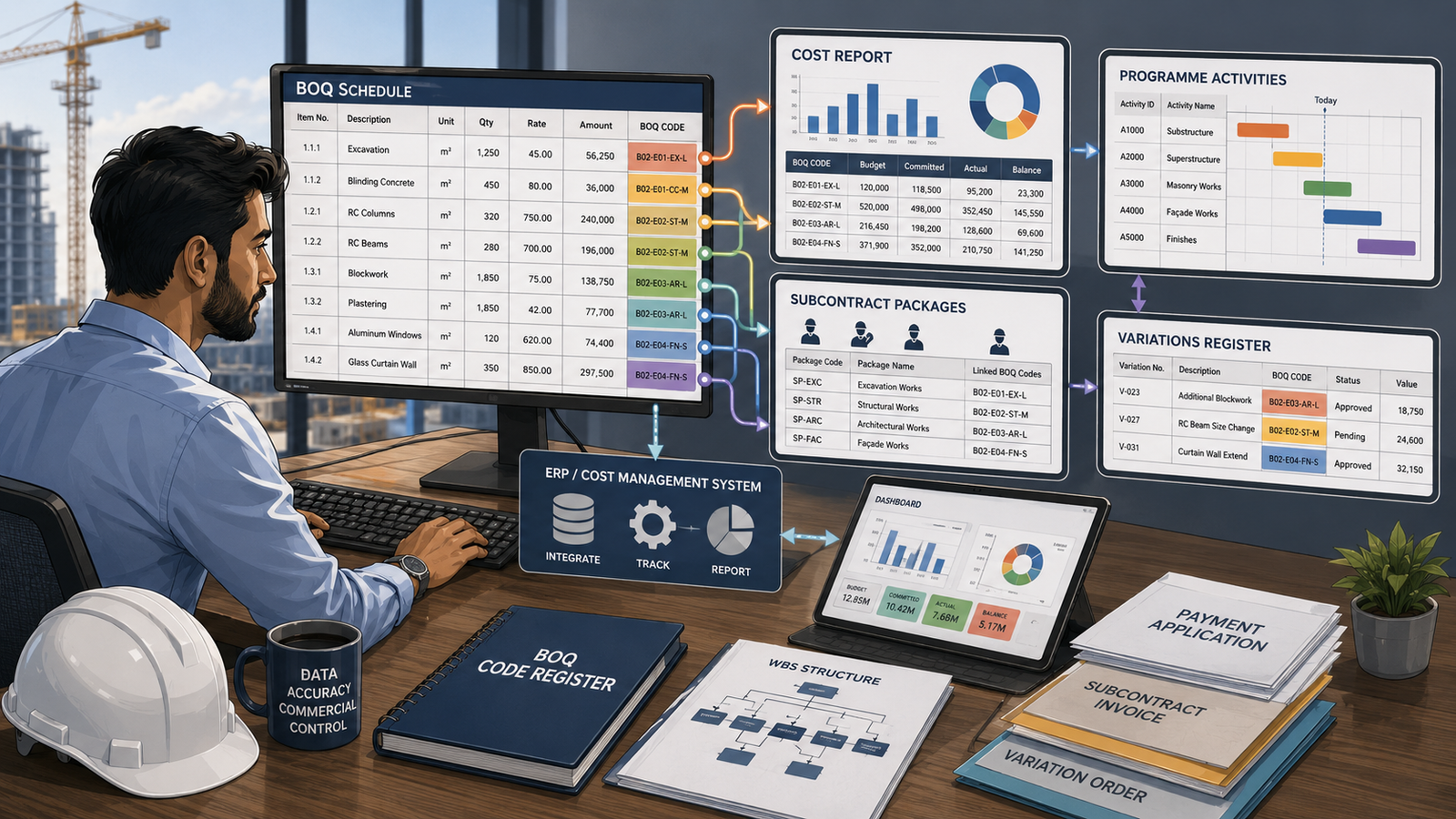
The principle is straightforward: a BOQ code is not simply a reference number. It is a data address. Every line item in the priced document needs a code that links it unambiguously to a cost center, a work package, a programme activity, and a reporting category. The failure to design this coding hierarchy before tender issue is one of the most costly oversights in commercial practice not because it ruins the tender, but because it ruins every month’s cost reporting that follows.
The reality on fast-track fit-out projects is particularly acute. When scope is changing, variations are being instructed daily, and subcontract packages are let in overlapping waves, a robust WBS-linked code structure is the only mechanism that keeps the financial picture coherent. Without it, the QS is perpetually reconstructing the picture from fragments rather than reading it directly from the system.
WHAT YOU WILL LEARN:
- How to design a BOQ coding hierarchy that aligns with WBS, cost codes, and programme activities
- The difference between elemental codes, work package codes, and cost centre codes
- How BOQ coding drives automated cost reporting and variation tracking
- Common coding failures that cause reconciliation problems mid-project
- How to retrofit a coding structure when the original is inadequate
BOQ CODING HIERARCHY
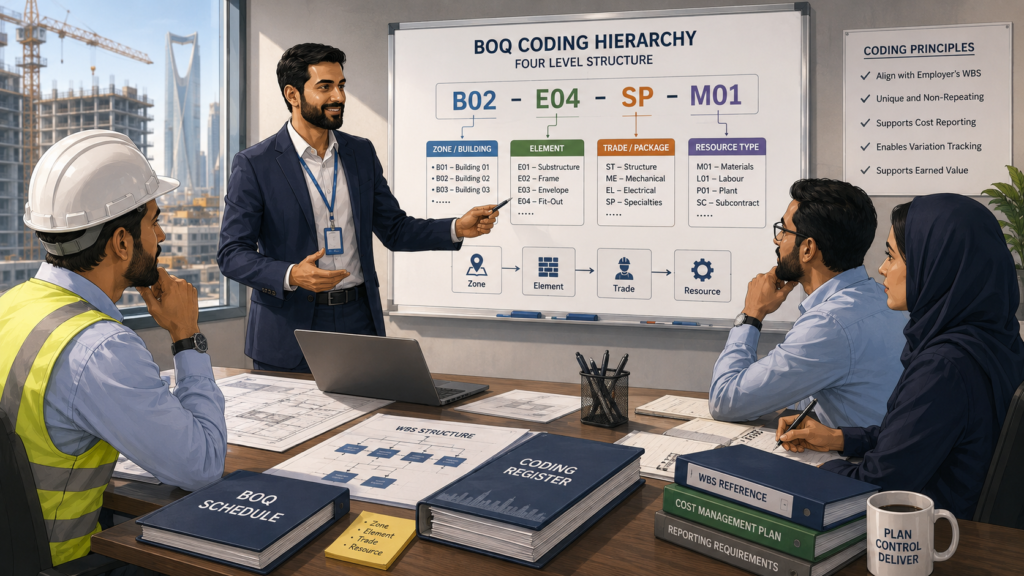
A well-designed BOQ code has four layers. The first identifies the cost centre or project zone (building, floor, or section). The second identifies the element (substructure, frame, envelope, fit-out). The third identifies the trade package or subcontract. The fourth identifies the item type (labour, material, plant, or subcontract lump sum). A five-character code such as B02-E04-SP-M01 communicates zone, element, trade, and resource type simultaneously.
Key considerations when designing the hierarchy:
- Align Level 1 codes with employer’s WBS if one is prescribed in the contract
- Ensure Level 2 elemental codes mirror the NRM2 or POMI elemental breakdown used in cost planning
- Reserve a dedicated prefix for Provisional Sums and Dayworks these need separate tracking
- Ensure every code is unique and non-repeating across zones to prevent aggregation errors
➤ A BOQ code that cannot be filtered and sorted in a pivot table is a code that will create manual reconciliation work every month.
LINK TO COST REPORTING
The connection between the BOQ and the cost report is established through the cost management system — whether that is Candy, CostX, an ERP platform, or Excel. Each BOQ code maps to a cost code in the financial system. When a payment application is assessed, the certified values flow against those cost codes. When a variation is agreed, it is allocated to the applicable code. When a subcontract invoice is approved, it is posted against the relevant package code.
Practical coding principles that support cost reporting:
- Assign a dedicated code series for preliminaries, time-related items, and fixed charges
- Create a separate code block for instructed variations not yet agreed — “open variation” tracking
- Link programme activity IDs to BOQ codes to enable earned value calculation
- Maintain a code register as a live document throughout the project
➤ When the BOQ code and the financial system cost code are the same, reconciliation time drops by more than 60 percent.
PRACTICAL QS APPROACH
Experienced commercial managers on major Saudi Arabia contracts establish the coding framework as a project start-up deliverable — not a post-contract afterthought. The process runs in parallel with mobilisation:
- Review the employer’s WBS and reporting requirements at contract award
- Design the four-level code hierarchy and circulate for approval within the first two weeks
- Load codes into the cost management system before the first payment application
- Brief the site team and subcontract managers on the code structure and how to reference it on dayworks and variation orders
- Issue a monthly coding compliance check — identifying any items posted without a valid code
FINAL THOUGHT
BOQ coding is dismissed as administrative work until the project reaches its first major dispute or audit. At that point, the quality of the coding structure determines whether the QS can produce a coherent financial narrative in hours or in weeks. Every project that runs without a proper coding hierarchy eventually pays the cost — in reconciliation time, in delayed final accounts, and in commercial positions that cannot be evidenced cleanly.
Because in reality:
- A BOQ without a WBS-linked code structure is a tender document, not a commercial management tool.
- The cost report is only as reliable as the data addresses that feed it.