
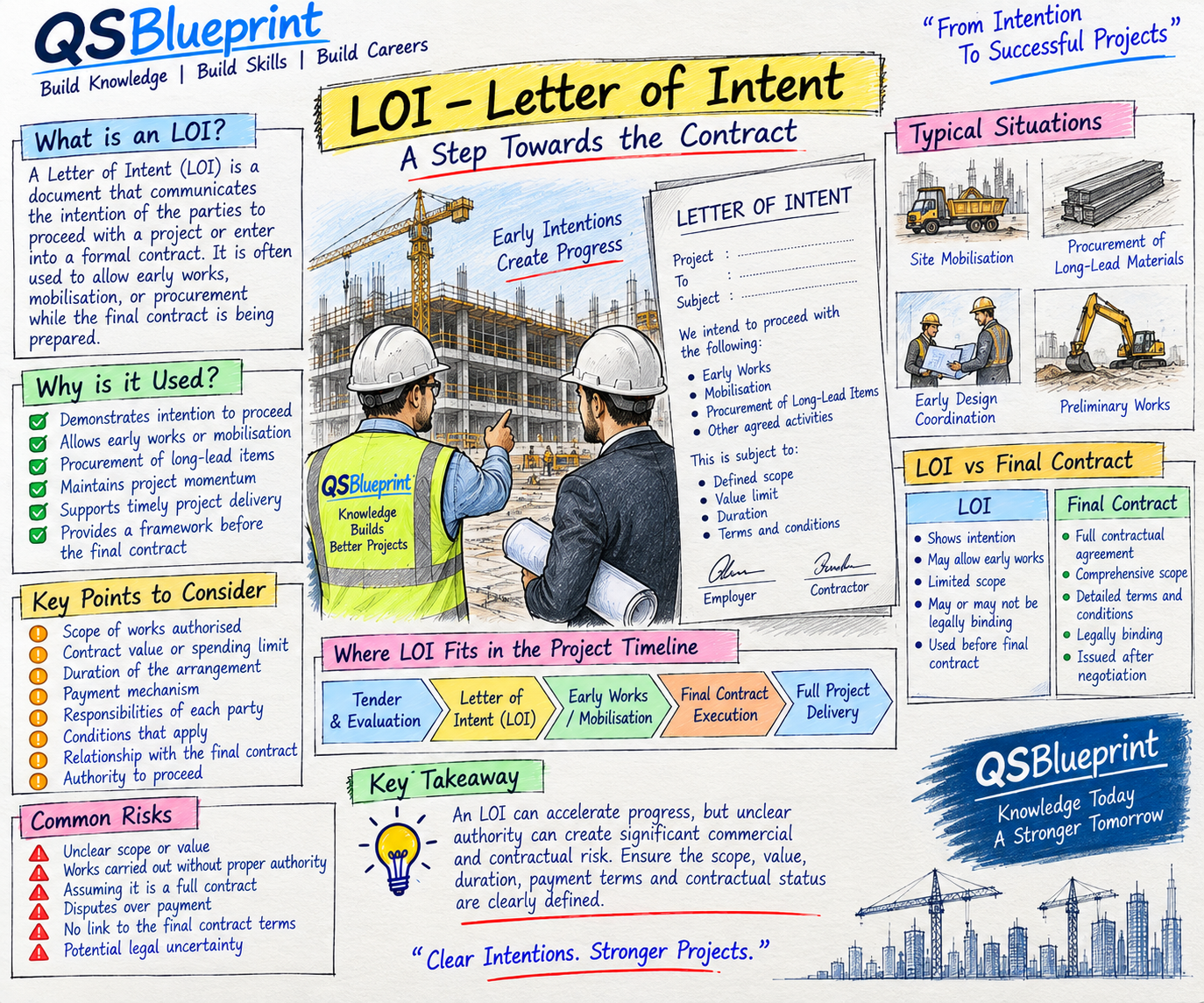
Letter of Intent (LOI) in Construction: A Practical QS Guide
A construction project does not always move directly from tender award to a fully executed contract.
Sometimes, the Employer wants certain activities to start while the final contract is still being prepared.
This is where a Letter of Intent (LOI) may be used.
What Is a Letter of Intent?
A Letter of Intent is a document that records the parties’ intention regarding a proposed project or arrangement and may, depending on its wording, authorise specific activities to proceed before the final contract is signed.
For example, an LOI may allow a contractor to begin:
- Site mobilisation
- Procurement of long-lead materials
- Early design coordination
- Preliminary works
- Specialist subcontractor engagement
However, an important point for a QS and Commercial Manager is:
An LOI should not automatically be treated as a full construction contract.
Its legal and commercial effect depends on its actual wording, the parties’ agreement, the scope authorised and the surrounding circumstances.
Under Saudi Arabia’s Civil Transactions Law, a contract is formed through the connection of offer and acceptance to create a legal effect, while the parties’ expressed intentions and the circumstances can be relevant to determining their agreement.
What Should a QS Check in an LOI?
Before allowing significant work to proceed, clearly identify:
- Scope – What work is actually authorised?
- Value – Is there a contract value or spending limit?
- Duration – How long does the LOI remain effective?
- Payment – How will completed work be valued and paid?
- Responsibilities – What obligations apply to each party?
- Contract terms – Which conditions apply during the LOI period?
- Final contract – What happens when the formal contract is executed?
- Termination – What happens if the final contract is not agreed?
The Commercial Risk
The biggest risk is not necessarily the LOI itself.
The risk comes when work continues without clear limits.
For example:
What work was authorised?
How much can the contractor spend?
How will the work be valued?
What happens if the final contract is never signed?
If these points are unclear, the project can quickly develop commercial and contractual uncertainty.
Practical QS Approach
Before certifying or valuing work under an LOI, make sure there is a clear record of:
Authorised Scope → Approved Value → Payment Basis → Time Limit → Applicable Conditions
Keep instructions, approvals, quotations, records and valuations properly documented.
An LOI should help the project move forward — not become an open-ended instruction to proceed.
Key Takeaway
An LOI can be useful when a project needs to start before the final contract is completed.
But from a QS perspective, the important question is not simply:
“Do we have an LOI?”
It is:
“What exactly does the LOI authorise, and what are the commercial limits?”
Understanding that distinction can help prevent avoidable disputes later in the project.