
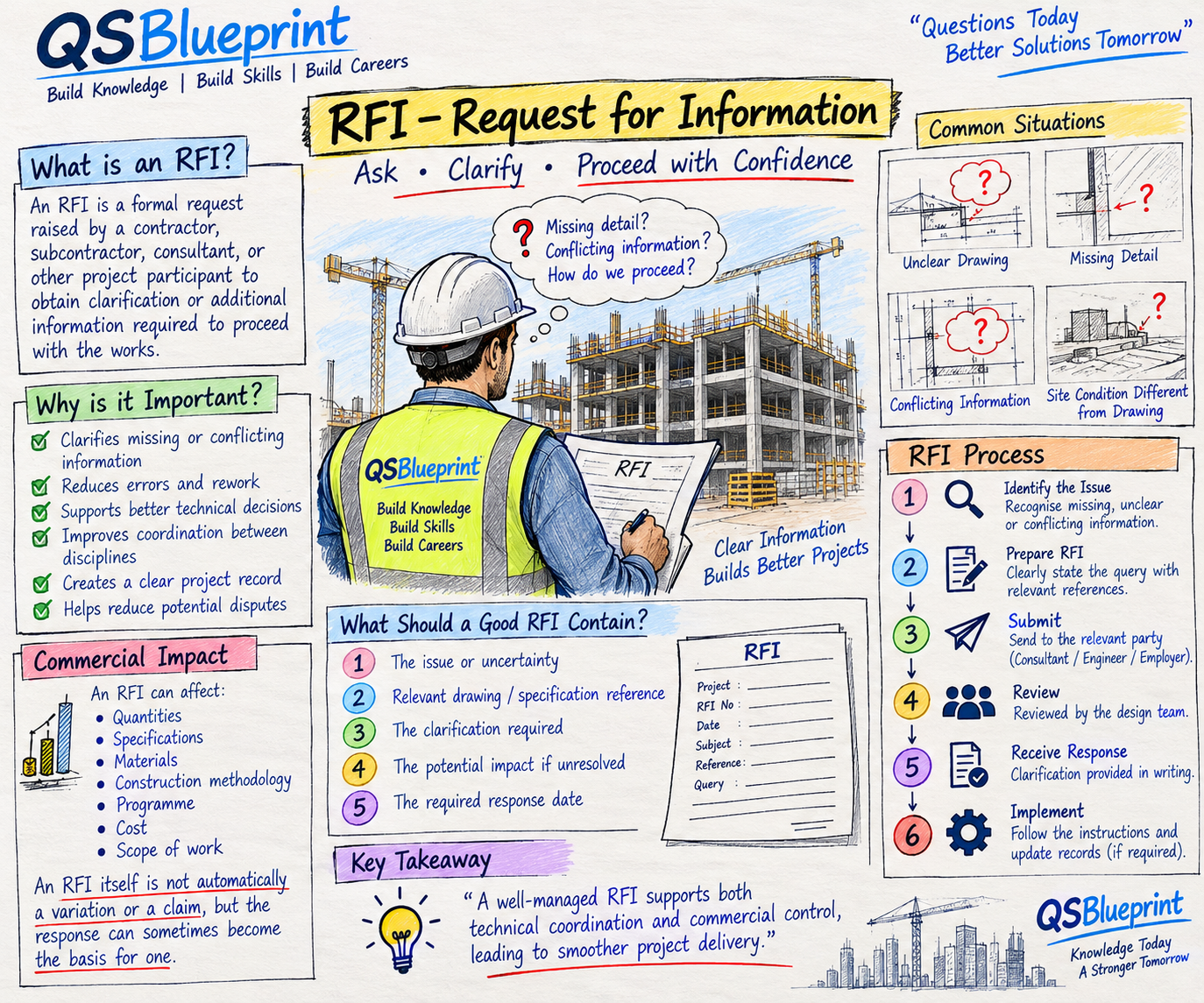
Request for Information (RFI) in Construction: A Practical QS Guide
Questions and uncertainties are common on construction projects.
A drawing may be missing a detail. A specification may be unclear. Two drawings may contain conflicting information. Or the actual site condition may differ from the design.
This is where a Request for Information (RFI) becomes an important project communication tool.
What Is an RFI?
A Request for Information (RFI) is a formal request used to obtain clarification or additional information needed to proceed with the works.
An RFI may be raised by a contractor, subcontractor, consultant or other project participant.
The purpose is simple:
Identify the issue → Ask for clarification → Receive a formal response → Record the decision.
Why Is an RFI Important?
A properly managed RFI can help to:
- Clarify missing or conflicting information
- Reduce assumptions and rework
- Improve coordination between disciplines
- Support technical decisions
- Maintain a clear project record
- Reduce the risk of future disputes
The value of an RFI is not just the question itself. The response becomes part of the project record and may help demonstrate why a particular decision was made.
Why Should a QS Care About RFIs?
An RFI can also have a commercial impact.
A response may affect:
- Quantities
- Materials
- Specifications
- Construction methodology
- Programme
- Cost
- Scope of work
For example, if a clarification requires a different material or additional work, the QS should assess whether there is a contractual entitlement to additional cost or time.
However:
An RFI is not automatically a variation or a claim.
The commercial consequence depends on what the clarification changes and what the contract says.
What Should a Good RFI Include?
A clear RFI should normally identify:
- The issue – What is unclear?
- Reference – Which drawing, specification or document is affected?
- Question – What clarification is required?
- Impact – What could happen if the issue remains unresolved?
- Required response – When is the clarification needed?
Avoid vague RFIs such as:
“Please clarify the drawing.”
Instead, identify the exact location, document reference and question.
The clearer the RFI, the easier it is for the responsible party to provide a useful response.
Practical QS Tip
Do not treat the RFI register as only a document-control tool.
From a commercial perspective, review important RFIs regularly and identify whether responses could affect:
Scope → Quantity → Cost → Time → Contractual Entitlement
This can help the commercial team identify potential changes early rather than discovering them when preparing a variation or claim months later.
Key Takeaway
A good RFI is clear, specific and properly documented.
It should remove uncertainty before work proceeds — not simply create another piece of paperwork.
For construction professionals, effective RFI management supports both technical coordination and commercial control.
The best RFI is not the longest one. It is the one that gets the right answer before the wrong work is done.
QSBlueprint
Practical Quantity Surveying | Commercial Management | Construction Contracts | Project Controls
For professional learning purposes. The contractual effect of an RFI depends on the project-specific contract and applicable conditions.